
Single Cultures
Algae Single Cultures
Chlorophytes
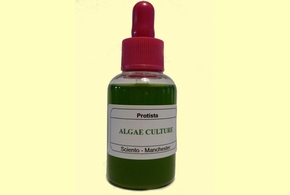
A25 Botryococcus braunii
Our very own strain, yielding a large cellular oil content.The floating planktonic cells are yellowish-green from the...
A48 Chlamydomonas nivalis
A small phototrophic phytoflagellate,good for showing motile,unicellular morphology.
A56 Chlamydomonas reinhardtii -ve
Heterothallic mating strains for demonstrating isogamous conjugation.
A60 Chlorella vulgaris
Our own vigorous strain easily cultured in simple Medium. Non-motile, spherical unicells with a single parietal chlo...
A61 Chlorella sp.
Smaller cells than A60.
Cells stay in suspension for several weeks, however the strain takes much longer to achieve ...
A67 Chlorococcum hypnosporum
Simple unicells with a prominent chloroplast and pyrenoid.\r\n50ml culture
A68 Chlorococcum sp.
50ml culture of concentrated unicellular algal food for feeding Water Bears. Cultures remain viable for several weeks...
A75 Cladophora sp.
Branched, filamentous alga with long cylindrical cells, each containing a compact reticulated chloroplast.Asexual rep...
A86 Closterium sp.
Exemplary species for showing textbook morphology. A beautiful example of a typical placoderm desmid, crescent shape...
A115 Dunaliella salina
Small halophilic biflagellate, the motile cells lack a cellulose wall and have only a cell membrane. Tolerates high s...
A127 Enteromorpha intestinalis
Marine, multicellular macro-algae with a hollow, tubular thalli one cell thick. Reproduces asexually by the formation...
A150 Haematococcus pluvialis (lacustris)
Unusual, motile unicells with two visibly distinct flagella and a protoplast suspended within the cell by cytoplasmic...
A161 Hydrodictyon reticulatum
'Water net' free floating macroscopic mesh-like colonies composed from thousands of interlinked cells. Asexual repr...
A174 Micrasterias thomasiana
A majestic placoderm species, highly recommended for inspiring an interest in algae. The large cells show colourful b...
A203 Mougeotia sp.
Filamentous alga similar to Spirogyra but having a flat, ribbon like (axial) chloroplast.
A241 Pandorina morum
Essentially a cluster of chlamydomonad cells enclosed in a gelatinous sheath to form an ovoid,motile colony.
A250 Pediastrum boryanum
Planktonic cells united in attractive, stellate colonies. The life cycle is remarkably complex and fascinating to study.
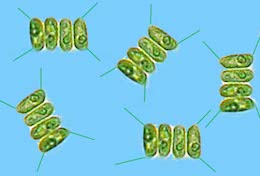
A290 Scenedesmus quadricauda
An excellent example of a typical planktonic algae and amenable for demonstrating photosynthetic, oxygen liberation a...
A327 Trentepohlia aurea
Red pigmented, filamentous aerophytic alga producing gametangia and sporangia.
A337 Volvox aureus
Most impressive of all the volvocales, with thousands of individual, flagellated cells forming a single colony (coeno...
A363 Zygnema cylindricum
Filamentous species with characteristic star-shaped (stellate) chloroplasts.
A140 Euastrum didelta
A superb naturally sculptured desmid isolated from a Snowdonia lake. 50ml culture
A205 Nannochloropsis oculata
Marine unicellular,non-motile alga and energy rich food for mariculture .
A good source of omega-3-fatty acids.
Dinophytes
A10 Peridinium foliaceum
A marine dinoflagellate, seasonal blooms can be the cause of \u2018red tides\u2019 which produce a toxin poisonous to...
A18 Woloszynskia sp.
A large, autotrophic freshwater dinoflagellate, the species is 'armoured' and shows numerous sculptured thecal plates.
A6 Oxyrrhis marina
Small marine dinoflagellate, no chloroplast, holozoic and ingests small microorganisms
A15 Bioluminescent Algae 250ml culture (Pyrocystis lunula)
Planktonic marine, bioluminescent dinoflagellate (Pyrocystis lunula) Demonstrates circadian rhythm controlled biolumi...
A5 Ceratium hirundinella
An intriguing brown planktonic dinoflagellate with prominent 'horns' and thecal plates.\r\n50ml culture
Bacillariophytes
A375 Asterionella formosa
A star shaped (stellate), planktonic diatom and a very good introductory species for illustrating the intriguing morp...
A386 Melosira varians
A filamentous, centrale diatom with circular valves, the frustules are linked end to end by mucilaginous secretion to...
A398 Nitzschia sp.
A typical freshwater pennate diatom having two axially adjacent chromatophores. Cells show typical gliding movement.
A403 Nitzschia longissima
An exemplary, marine planktonic species with long tapering frustules terminating in needle-like spines.
A415 Stauroneis sp.
An excellent example of a large pennate diatom. Lanceolate frustules with intense brown pigment.
A428 Tabellaria sp.
Long chains of rectangular frustules linked together in characteristic zig-zag fashion
Xanthophytes
A439 Vaucheria sessilis
A filamentous algae which lacks a transverse cell wall (coenocytic), the species is homothallic and develops asexual ...
Chrysophytes
A448 Synura sp.
A colonial flagellate with pear-shaped cells that have no cell wall but have a periplast embedded with spirally arran...
Haptophytes
Cryptophytes
A465 Chroomonas sp.
Small vigorously motile freshwater species with distinctive blue/green chloroplasts
Cyanobacteria
A490 Anabaena Cylindrica
Filaments of bead-like cells with conspicuous, intercalary heterocysts. An excellent species for investigating cyanob...
A541 Microcystis sp.
Colonies of compact,spherical cells; often forming seasonal \u2018algal blooms\u2019 which can be toxic to fauna.
A550 Nostoc sp.
Unusual, jelly-like colonies of twisted trichomes embedded in a mucilaginous secretion. Colonies need to be crushed u...
A565 Oscillatoria animalis
Simple, unbranched multicellular filament.The trichomes exhibit positive phototactic response towards light and show ...
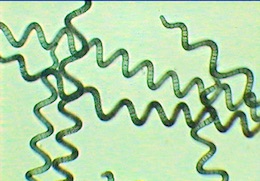
A583 Spirulina (Arthrospira) platensis
Large spiral trichomes and an excellent cyanophyte demonstration species.
NOT FOR HUMAN CONSUMPTION. .
A595 Tolypothrix sp.
Tufts of trichomes, an efficient nitrogen fixer and used for \u2018seeding\u2019 paddy fields.Shows false branching.
A591 Synechoccus leopoliensis
Simple, planktonic mucilaginous,single cells.\r\nSyn.Anacystis nidulans
Rhodophytes
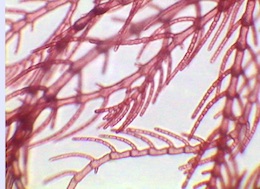
A600 Antithamnion plumula
A colourful example of a red, filamentous marine alga to exemplify their complex and interesting life cycle.\r\n50ml ...
Phaeophytes
A629 Ectocarpus variabilis
Branched, filamentous alga, often epiphytic and attached by a rhizoidal base. The complex life cycle involves both h...
Chlorophytes
A25 Botryococcus braunii
Our very own strain, yielding a large cellular oil content.The floating planktonic cells are yellowish-green from the cells oil contents.When squashed under a coverslip the cells release globules of oil. Accumulated residual deposits are source of coal & o...
A20 Ankistrodesmus spiralis
Planktonic needle-like unicells.
A29 Carteria sp.
Similar to Chlamydomonas but with 4 flagella.
A48 Chlamydomonas nivalis
A small phototrophic phytoflagellate,good for showing motile,unicellular morphology.
A56 Chlamydomonas reinhardtii -ve
Heterothallic mating strains for demonstrating isogamous conjugation.
A60 Chlorella vulgaris
Our own vigorous strain easily cultured in simple Medium. Non-motile, spherical unicells with a single parietal chloroplast. Useful alga for showing oxygen liberation during photosynthesis. Or for use in haemacytometers as substitute for blood corpuscles.
A61 Chlorella sp.
Smaller cells than A60.
Cells stay in suspension for several weeks, however the strain takes much longer to achieve a dense culture.
A67 Chlorococcum hypnosporum
Simple unicells with a prominent chloroplast and pyrenoid.\r\n50ml culture
A68 Chlorococcum sp.
50ml culture of concentrated unicellular algal food for feeding Water Bears. Cultures remain viable for several weeks . Chlorococcum cells are non-motile and will have settled out on the bottom of the culture vessel on arrival. These concentrated cells can ...
A75 Cladophora sp.
Branched, filamentous alga with long cylindrical cells, each containing a compact reticulated chloroplast.Asexual reproduction is by quadriflagellate zoospores. The life cycle illustrates an isomorphic alternation of a diploid asexual generation with a ha...
A86 Closterium sp.
Exemplary species for showing textbook morphology. A beautiful example of a typical placoderm desmid, crescent shaped unicells containing two chloroplasts with several distinct pyrenoids.
A88 Closterium acerosum
Very large, elongated form.
A95 Cylindrocystis sp.
Attractive desmid with 2 stellate chloroplasts.
A98 Derbesia tenuissima
Gametophytic 'halicystis' and diploid 'derbesia' generations.
A101 Desmidium sp.
Typical filamentous placoderm sp.
A107 Dictyosphaerium pulchellum
Mucilaginous colonial cells joined together by old cell walls.
A115 Dunaliella salina
Small halophilic biflagellate, the motile cells lack a cellulose wall and have only a cell membrane. Tolerates high salinity and is generally found in brackish and marine waters.
A127 Enteromorpha intestinalis
Marine, multicellular macro-algae with a hollow, tubular thalli one cell thick. Reproduces asexually by the formation of quadriflagellate zoospores, and sexually by isogametous fusion of biflagellate gametes produced from heterothallic filaments.
A132 Eremosphaera viridis
Large unicells with many discoid chloroplasts
A135 Eudorina elegans
Colonies (coenobia) of up to 64 biflagellate cells.
A142 Gonium sociale
Simple flat, plate-like colonies (plakea) of biflagellate cells.
A150 Haematococcus pluvialis (lacustris)
Unusual, motile unicells with two visibly distinct flagella and a protoplast suspended within the cell by cytoplasmic strands. Cells exposed to intense illumination form bright red (haematochrome) akinetes or cysts.
A152 Haematococcus pluvialis cysts
Concentrated culture of viable red cysts ( akinetes).
A161 Hydrodictyon reticulatum
'Water net' free floating macroscopic mesh-like colonies composed from thousands of interlinked cells. Asexual reproduction is prolific and creates multiple daughter nets which can become invasive in lakes over summer.
A174 Micrasterias thomasiana
A majestic placoderm species, highly recommended for inspiring an interest in algae. The large cells show colourful bilateral symmetry and two extensive chloroplasts. A very attractive and rewarding desmid to observe.
A180 Netrium interruptum
Large placoderm desmid having several chloroplasts.
A185 Microspora amoena
Filamentous with overlapping H-cell walls;zoosporic.
A203 Mougeotia sp.
Filamentous alga similar to Spirogyra but having a flat, ribbon like (axial) chloroplast.
A208 Oedogonium foveolatum
Homothallic filamentous sp.,produces zoospores
A210 Oedogonium cardiacum
Heterothallic female strain.
A221 Onchonema sp.
Filamentous desmid with cells joined by spines.
A241 Pandorina morum
Essentially a cluster of chlamydomonad cells enclosed in a gelatinous sheath to form an ovoid,motile colony.
A250 Pediastrum boryanum
Planktonic cells united in attractive, stellate colonies. The life cycle is remarkably complex and fascinating to study.
A258 Pithophora sp.
Filamentous alga showing akinetes.
A263 Platymonas sp.
Easily cultured marine 'food flagellate' for aquaculture.
A265 Pleodorina sp.
Large attractive volvocale.
A267 Pleurococcus sp.
Simple terrestrial, palmelloid alga.
A271 Pleurotaenium sp.
A very large and attractive, elongate placoderm desmid.
A280 Pyramimonas sp.
Marine, quadriflagellate cells
A287 Scenedesmus acuminatus
Simple coenobia of 4 to 8 cells, reproduces by autospores.
A290 Scenedesmus quadricauda
An excellent example of a typical planktonic algae and amenable for demonstrating photosynthetic, oxygen liberation and primary productivity.
A294 Selanastrum gracile
Clusters of planktonic lunate unicells.
A300 Spirogyra sp.
Multichloroplast strain with a conspicuous nucleus.
A314 Staurastrum gracile
Placoderm desmid with triangular cells
A318 Stephanosphaera pluvialis
Small elegant colonies of biflagellated cells
A322 Stigeoclonium farctum
Filamentous cells readily produces flagellated spores.
A324 Tetraselmis suecica
Marine quadriflagellate used as aquaculture food organism.
A327 Trentepohlia aurea
Red pigmented, filamentous aerophytic alga producing gametangia and sporangia.
A334 Ulothrix confervicola
Filamentous; reproduces by asexual & sexual motile spores.
A337 Volvox aureus
Most impressive of all the volvocales, with thousands of individual, flagellated cells forming a single colony (coenobia) and often with interior daughter colonies present.
A340 Volvox tertuis
Colonies of cells without cytoplasmic connections.
A363 Zygnema cylindricum
Filamentous species with characteristic star-shaped (stellate) chloroplasts.
A155 Hyalotheca dissilens
Mucilaginous filamentous Desmid
A350 Xanthidium sp.
Spiny Desmid
A139 Euastrum crassum
An ornamented placoderm Desmid
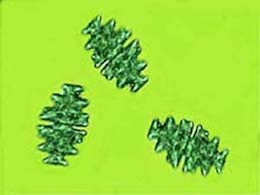
A138 Euastrum pinnatum
A small sculptured desmid
A182 Netrium digitus
Large, attractive pennate cells with deeply indented chloroplasts
A140 Euastrum didelta
A superb naturally sculptured desmid isolated from a Snowdonia lake. 50ml culture
A205 Nannochloropsis oculata
Marine unicellular,non-motile alga and energy rich food for mariculture .
A good source of omega-3-fatty acids.
Dinophytes
A3 Amphidinium sp.
Marine dinoflagellate, naked membranous theca.
A8 Peridinium sp.
Large freshwater 'armoured' dinoflagellate
A10 Peridinium foliaceum
A marine dinoflagellate, seasonal blooms can be the cause of \u2018red tides\u2019 which produce a toxin poisonous to fish.
A13 Prorocentrum sp.
Primitive toxic marine dinoflagellate with bivalve theca.
A18 Woloszynskia sp.
A large, autotrophic freshwater dinoflagellate, the species is 'armoured' and shows numerous sculptured thecal plates.
A6 Oxyrrhis marina
Small marine dinoflagellate, no chloroplast, holozoic and ingests small microorganisms
A15 Bioluminescent Algae 250ml culture (Pyrocystis lunula)
Planktonic marine, bioluminescent dinoflagellate (Pyrocystis lunula) Demonstrates circadian rhythm controlled bioluminescence. The algae needs to be kept at room temperature (15-23 Celsius) in the light for approx.12 hours (to simulate a daylight photoperio...
A5 Ceratium hirundinella
An intriguing brown planktonic dinoflagellate with prominent 'horns' and thecal plates.\r\n50ml culture
Bacillariophytes
A384 Gyrosigma sp.
Large sigmoid diatom excellent for showing typical gliding movement
A375 Asterionella formosa
A star shaped (stellate), planktonic diatom and a very good introductory species for illustrating the intriguing morphology and diversity of shape unique to these silicified algae.
A379 Fragilaria crotonensis
An excellent filamentous sp. Isolated from Crosemere.
A386 Melosira varians
A filamentous, centrale diatom with circular valves, the frustules are linked end to end by mucilaginous secretion to form long cylindrical filaments, The filaments frequently show auxospore formation.
A389 Navicula sp.
Characteristic 'boat-shaped' valves with distinct raphe.
A398 Nitzschia sp.
A typical freshwater pennate diatom having two axially adjacent chromatophores. Cells show typical gliding movement.
A403 Nitzschia longissima
An exemplary, marine planktonic species with long tapering frustules terminating in needle-like spines.
A408 Phaeodactylum tricornutum
A prolific marine 'food diatom' for aquaculture use.
A411 Pinnularia nobilis
A large, ornamented pennate species; an aristocrat amongst diatoms.
A415 Stauroneis sp.
An excellent example of a large pennate diatom. Lanceolate frustules with intense brown pigment.
A420 Stephanodiscus sp.
A round (centric) planktonic diatom from Crosemere.
A425 Synedra sp.
Large, elongated pennate diatom.
A428 Tabellaria sp.
Long chains of rectangular frustules linked together in characteristic zig-zag fashion
A383 Gomphonema sp.
Large pennate with undulating frustules
A376 Cyclotella cryptica
Small marine circular (centrale) diatom.
A377 Cymatopleura solea
Freshwater pennate diatom with attractive undulating frustules
Xanthophytes
A432 Botrydium granulatum
Terrestrial, siphonaceous vesicles; zoosporic.
A436 Tribonema viride
Zoosporic filaments which form H-walled cells.
A439 Vaucheria sessilis
A filamentous algae which lacks a transverse cell wall (coenocytic), the species is homothallic and develops asexual and sexual stages in culture. Observation of the filaments often reveals zoosporangia, oogonia and antherdia. Zoospores are readily liberate...
Chrysophytes
A441 Ochromonas danica
Tiny, biflagellate chrysomonad, two unequal flagella.
A448 Synura sp.
A colonial flagellate with pear-shaped cells that have no cell wall but have a periplast embedded with spirally arranged siliceous scales. Each cell contains two golden brown chromatophores and the cells are united by posterior stalks to form radiately arra...
Haptophytes
A454 Coccolithophora sp.
Shows coccoliths on cell wall.
A461 Isochrysis galbana (Tahitian strain)
Easily cultured marine 'food flagellate'.
Cryptophytes
A470 Chroomonas salina
Marine 'food flagellate' for aquaculture.
A474 Cryptomonas ovata
Freshwater cryptomonad with brown pigmented cells.
A482 Rhodomonas baltica
Red pigmented marine cryptomonad.
A476 Cryptomonas sp,
A vigorous motile freshwater species with distinctive brown chloroplasts
A465 Chroomonas sp.
Small vigorously motile freshwater species with distinctive blue/green chloroplasts
A480 Rhodomonas sp.
Small motile freshwater flagellate with distinctive red/brown chloroplasts.
Cyanobacteria
A490 Anabaena Cylindrica
Filaments of bead-like cells with conspicuous, intercalary heterocysts. An excellent species for investigating cyanobacteria morphology and life cycle.\r\n
A498 Chroococcus prescotti
Mucilaginous coccoid colonies of up to 8 cells.
A503 Fischerella muscicola
Multiseriate, branched filaments.
A520 Gloeocapsa sp.
Colonies of simple, spherical unicells surrounded by a gelatinous sheath.
A526 Gloeotrichia longicauda ..Regret OUT OF STOCK
Tapering trichomes showing basal heterocysts.
A530 Lyngbya sp.
Filamentous mats of uniseriate trichomes.
A541 Microcystis sp.
Colonies of compact,spherical cells; often forming seasonal \u2018algal blooms\u2019 which can be toxic to fauna.
A547 Nodularia sp.
Marine filamentous species. Shows intercalary heterocysts.
A550 Nostoc sp.
Unusual, jelly-like colonies of twisted trichomes embedded in a mucilaginous secretion. Colonies need to be crushed under a coverslip to observe the multicellular trichomes, often with heterocysts, akinetes and hormogonia.
A565 Oscillatoria animalis
Simple, unbranched multicellular filament.The trichomes exhibit positive phototactic response towards light and show typical gliding movement over the substrate.
A578 Phormidium sp.
Much better than Oscillatoria for showing filamentous cells and hormogonia.
A583 Spirulina (Arthrospira) platensis
Large spiral trichomes and an excellent cyanophyte demonstration species.
NOT FOR HUMAN CONSUMPTION. .
A588 Stigonema sp.
Shows true branching and multiseriate cell formation.
A595 Tolypothrix sp.
Tufts of trichomes, an efficient nitrogen fixer and used for \u2018seeding\u2019 paddy fields.Shows false branching.
A591 Synechoccus leopoliensis
Simple, planktonic mucilaginous,single cells.\r\nSyn.Anacystis nidulans
Rhodophytes
A556 Acrochaetium sp.
Epithytic branched filaments;monospores.
A600 Antithamnion plumula
A colourful example of a red, filamentous marine alga to exemplify their complex and interesting life cycle.\r\n50ml culture
A604 Audouinella tetraspora
Branched filamentous marine alga which shows carpogonia.
A610 Batrachospermum sp.
A superb freshwater 'red' alga with a fascinating life cycle
A620 Membranoptera sp.
Beautiful thalloid red alga with deep crimson fronds.\r\n50ml culture.
A625 Porphyridium purpureum
Single spherical cells united in a colonial mucilage.
Phaeophytes
A629 Ectocarpus variabilis
Branched, filamentous alga, often epiphytic and attached by a rhizoidal base. The complex life cycle involves both haploid and diploid generations.
A651 Halopteris sp.
Elegantly branched, 'Sea Fern'
A710 Sphacelaria sp.
Large -celled, branched thallus.