Chlorophytes
(Green Algae)
-
A25 Botryococcus braunii
Our very own strain, yielding a large cellular oil content. The floating planktonic cells are yellowish/green from the cells oil ...
-
A20 Ankistrodesmus spiralis
Planktonic needle-like unicells.
-
A29 Carteria sp.
Similar to Chlamydomonas but with 4 flagella.
-
A48 Chlamydomonas nivalis
A small phototrophic phytoflagellate,good for showing motile,unicellular morphology.
-
A54 Chlamydomonas reinhardtii +ve
-
A56 Chlamydomonas reinhardtii -ve
Heterothallic mating strains for demonstrating isogamous conjugation.
-
A60 Chlorella vulgaris
Monotonous, non-motile, tiny spherical unicells with a single parietal chloroplast.Occurs free living and as a symbiont zoochlorellae in some protists,eg. ...
-
A61 Chlorella sp.
Large, robust sp. easily cultured and maintained.
-
A67 Chlorococcum hypnosporum
Simple unicells with a prominent chloroplast and pyrenoid. 50ml culture
-
A68 Chlorococcum sp.
-
A75 Cladophora sp.
Branched, filamentous alga with long cylindrical cells, each containing a compact reticulated chloroplast.Asexual reproduction is by quadriflagellate zoospores. The life ...
-
A86 Closterium sp.
Exemplary species for showing textbook morphology. A beautiful example of a typical placoderm desmid, crescent shaped unicells containing two chloroplasts ...
-
A88 Closterium acerosum
Very large, elongated form.
-
A95 Cylindrocystis sp.
Attractive desmid with 2 stellate chloroplasts.
-
A98 Derbesia tenuissima
Gametophytic 'halicystis' and diploid 'derbesia' generations.
-
A101 Desmidium sp.
Typical filamentous placoderm sp.
-
A107 Dictyosphaerium pulchellum
Mucilaginous colonial cells joined together by old cell walls.
-
A115 Dunaliella salina
Small halophilic biflagellate, the motile cells lack a cellulose wall and have only a cell membrane. Tolerates high salinity and ...
-
A116 Dunaliella tertiolecta
-
A127 Enteromorpha intestinalis
Marine, multicellular macro-algae with a hollow, tubular thalli one cell thick. Reproduces asexually by the formation of quadriflagellate zoospores, and ...
-
A132 Eremosphaera viridis
Large unicells with many discoid chloroplasts
-
A135 Eudorina elegans
Colonies (coenobia) of up to 64 biflagellate cells.
-
A142 Gonium sociale
Simple flat, plate-like colonies (plakea) of biflagellate cells.
-
A150 Haematococcus pluvialis (lacustris)
Unusual, motile unicells with two visibly distinct flagella and a protoplast suspended within the cell by cytoplasmic strands. Cells exposed ...
-
A152 Haematococcus pluvialis cysts
Concentrated culture of viable red cysts ( akinetes).
-
A161 Hydrodictyon reticulatum
'Water net' free floating macroscopic mesh-like colonies composed from thousands of interlinked cells. Asexual reproduction is prolific and creates multiple ...
-
A174 Micrasterias thomasiana
A majestic placoderm species, highly recommended for inspiring an interest in algae. The large cells show colourful bilateral symmetry and ...
-
A180 Netrium interruptum
Large placoderm desmid having several chloroplasts.
-
A185 Microspora amoena
Filamentous with overlapping H-cell walls;zoosporic.
-
A203 Mougeotia sp.
Filamentous alga similar to Spirogyra but having a flat, ribbon like (axial) chloroplast.
-
A208 Oedogonium foveolatum
Homothallic filamentous sp.,produces zoospores
-
A210 Oedogonium cardiacum
Heterothallic female strain.
-
A221 Onchynema sp.
Filamentous desmid with cells joined by spines.
-
A241 Pandorina morum
Essentially a cluster of chlamydomonad cells enclosed in a gelatinous sheath to form an ovoid,motile colony.
-
A250 Pediastrum boryanum
Planktonic cells united in attractive, stellate colonies. The life cycle is remarkably complex and fascinating to study.
-
A258 Pithophora sp.
Filamentous alga showing akinetes.
-
A263 Platymonas sp.
Easily cultured marine 'food flagellate' for aquaculture.
-
A265 Pleodorina sp.
Large attractive volvocale.
-
A267 Pleurococcus sp.
Simple terrestrial, palmelloid alga.
-
A271 Pleurotaenium sp.
A very large and attractive, elongate placoderm desmid.
-
A280 Pyramimonas sp.
Marine, quadriflagellate cells
-
A287 Scenedesmus acuminatus
Simple coenobia of 4 to 8 cells, reproduces by autospores.
-
A290 Scenedesmus quadricauda
An excellent example of a typical planktonic algae and amenable for demonstrating photosynthetic, oxygen liberation and primary productivity.
-
A294 Selanastrum gracile
Clusters of planktonic lunate unicells.
-
A300 Spirogyra sp.
Multichloroplast strain with a conspicuous nucleus.
-
A314 Staurastrum gracile
Placoderm desmid with triangular cells
-
A318 Stephanosphaera pluvialis
Small elegant colonies of biflagellated cells
-
A322 Stigeoclonium sp.
Filamentous cells readily produces flagellated spores
-
A324 Tetraselmis suecica
Marine quadriflagellate used as aquaculture food organism.
-
A327 Trentepohlia aurea
Red pigmented, filamentous aerophytic alga producing gametangia and sporangia.
-
A334 Ulothrix sp.
Filamentous; reproduces by asexual & sexual motile spores.
-
A337 Volvox aureus
Most impressive of all the volvocales, with thousands of individual, flagellated cells forming a single colony (coenobia) and often with ...
-
A340 Volvox tertuis
Colonies of cells without cytoplasmic connections.
-
A363 Zygnema cylindricum
Filamentous species with characteristic star-shaped (stellate) chloroplasts.
-
A140 Euastrum didelta
A superb naturally sculptured desmid isolated from a Snowdonia lake.
-
A155 Hyalotheca dissilens
Mucilaginous filamentous Desmid
-
A350 Xanthidium sp.
Spiny Desmid
-
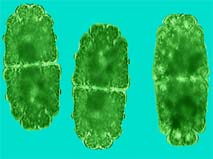 A139 Euastrum crassum
An ornamented placoderm Desmid
A139 Euastrum crassum
An ornamented placoderm Desmid
-
A138 Euastrum pinnatum
A small sculptured desmid
-
A182 Netrium digitus
Large, attractive pennate cells with deeply indented chloroplasts