Ciliates
-
P120 Acineria incurvata
Predatory ciliate which feeds on Rotifers (Philodina sp.). Forms resistant cysts
-
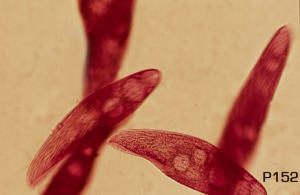 P152 Blepharisma sp.
A remarkable pink coloured protist and probably the best example of all for showing typical ciliate morphology.The naturally stained pink ...
P152 Blepharisma sp.
A remarkable pink coloured protist and probably the best example of all for showing typical ciliate morphology.The naturally stained pink ...
-
P165 Bursaria truncatella
A very large predator up to 1mm, which has a voracious appetite for other ciliates, engulfing food prey like a ...
-
W167 Carchesium sp.
Wild collected sample of colonial peritrichs.
-
P169 Climacostomum virens
A prodigious spirotrich with an awesome appetite for planktonic algae and phytoflagellates.
-
P174 Coleps hirtus
Gymnostome ciliate with ‘armoured’ pellicular plates.
-
P177 Colpidium striatum
A small bactivorous ciliate and ideal food prey for Podophyra, Actinosphaerium, Amoeba, and other predatory protists.
-
P180 Colpoda steinii
Small bactivorous soil ciliate which encysts
-
P195 Cyclidium sp.
Tiny scuticociliate with long thigmotactic cilia.
-
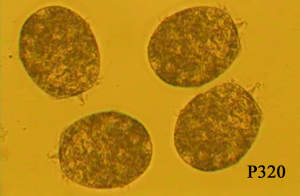 P220 Didinium nasutum
A voracious predator of Paramecium which it immobilises by discharging toxicysts which penetrate the pellicle. Dormant cysts are formed when ...
P220 Didinium nasutum
A voracious predator of Paramecium which it immobilises by discharging toxicysts which penetrate the pellicle. Dormant cysts are formed when ...
-
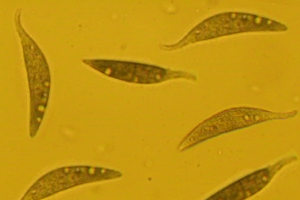 P225 Dileptus anser
A large and unusual predatory haptorid which uses its long probing ‘trunk’ to capture smaller protists. The culture contains Colpidium ...
P225 Dileptus anser
A large and unusual predatory haptorid which uses its long probing ‘trunk’ to capture smaller protists. The culture contains Colpidium ...
-
W227 Epistylis sp.
100ml Wild collected sample of an epizoitic peritrich.
-
P229 Euplotes daidaleos
A small green hypotrich containing symbiotic zoochlorellae.
-
P231 Euplotes patella
A very appealing example of a typical hypotrich that exemplifies the diversity of form amongst the ciliates. Their characteristic cirri ...
-
P233 Euplotes sp.
A Large hypotrich and common intertidal marine species.
-
P242 Frontonia sp.
An algivorous sp., which feeds on diatoms. 50ml culture
-
P245 Frontonia vernalis
Green coloured sp. containing zoochlorellae. 50ml culture
-
P255 Halteria grandinella
Characteristic bactivorous ‘bouncing’ ciliate.
-
P258 Holosticha sp.
Large flexible hypotrich, feeds mainly on diatoms.
-
P270 Lacrymaria olor
An astonishing ‘swan-like’ ciliate with a mouth at the end of a flexible ‘neck’.The neck detects suitable protists to eat..The ...
-
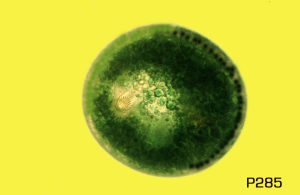 P285 Nassula sp.
Beautiful dark green ciliate which only eats filamentous ‘blue-green algae’, and after feasting forms golden cysts. Cultures arrive with adequate ...
P285 Nassula sp.
Beautiful dark green ciliate which only eats filamentous ‘blue-green algae’, and after feasting forms golden cysts. Cultures arrive with adequate ...
-
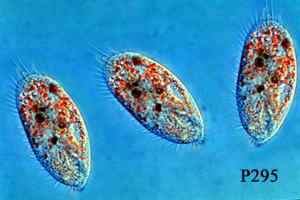 P295 Oxytricha sp.
Hypotrich with two macronuclei.
P295 Oxytricha sp.
Hypotrich with two macronuclei.
-
P302 Paramecium aurelia
Smaller species with one macro & two micronuclei.
-
P305 Paramecium bursaria
An excellent example of a symbiotic relationship with an algae. The green colouration of the ciliate is imparted by the ...
-
P320 Paramecium caudatum
The 'slipper animalcule' named after the resemblance of its pellicle to the shape of a slipper. Probably the most popular ...
-
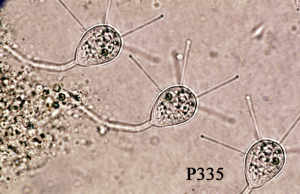 P335 Podophyra (discophyra) collini
An exemplary carnivorous suctorian for demonstrating the characteristic tentacular feeding mechanisms.The effectiveness of the tentacles for capturing and ingesting the ...
P335 Podophyra (discophyra) collini
An exemplary carnivorous suctorian for demonstrating the characteristic tentacular feeding mechanisms.The effectiveness of the tentacles for capturing and ingesting the ...
-
P341 Spathidium sp.
Predatory haptorid with peristomial trichites.
-
P346 Spirostomum ambiguum
One of the largest ciliates, up to 4mm in length and preferring nearly anaerobic (polysaprobic) conditions where organic decay sustains ...
-
P350 Spirostomum teres
A recommended species much better and larger than Paramecium for showing ciliary membranelles, the clearer endoplasm reveals a central macronucleus ...
-
P365 Stentor coeruleus
The textbook 'Trumpet animalcule' a large bluish-green pigmented species with a visibly distinct lobular macronucleus. A prominent crown of membranelles ...
-
P368 Stentor polymorphus
Beautiful 'green colouration' from symbiotic zoochlorellae.
-
P370 Stentor roeseli
Graceful and slender non-pigmented species with lorica.
-
P376 Strombidium sp.
Planktonic oligotrich which ingests bacteria and unicellular algae.
-
P380 Stylonychia mytilus
A large and visibly interesting hypotrich, ideal for studying ciliary organelles, feeding and locomotion. Forms dormant viable cysts.
-
P387 Tachysoma sp.
Large onnivorous hypotrich with dorsal bristles.
-
P391 Telotrochidium henneguyi
Large free swimming stalkless peritrich..
-
P395 Tetrahymena pyriformis
Small hymenostome ciliate.
-
P400 Tillina magna
Curious bactivorous holotrich, forms cysts.
-
P427 Urocentrum turbo
Ciliated girdle and dorsal tail for rapid spinning motility. 50ml culture
-
P431 Uroleptus longicauda
Long algivorous hypotrich with 'tail'
-
P434 Uronychia setigera
Estuarine sp. with compounf cirri.
-
P440 Vorticella similis
The 'Bell animalcule' a good example of a stalked peritrich, the mature stage (zooid) is attached to the substratum by ...
-
P275 Loxodes magnus
Large elongate, interstitial ciliate found in freshwater anoxic sediments. Predaceous on smaller protists. Cultures contain food prey and sediment to ...
-
P260 Homalozoon vermiculare
A large predatory, ribbon like ciliate. Cells are quite flexible and have a row of conspicuous contractile vacuoles. Cultures may ...
-
P250 Glaucoma sp.
Small vigorous,marine ciliate.
-
P261 Keronopsis rubrum
A large fascinating, marine hypotrich, reddish-brown cells. Highly flexible and adheres strongly to the substrate. Feeds on diatoms.